Golfers from all over Italy—and beyond—get ready for a small revolution… in a reduced format!
Starting in 2025, the way golf courses can obtain federal certification is changing. With the new guidelines of the World Handicap System (WHS)—officially adopted by the Italian Golf Federation (FIG)—a more inclusive and “flexible” system is coming into force, opening the doors of competitive golf to more compact facilities.
What does this mean?
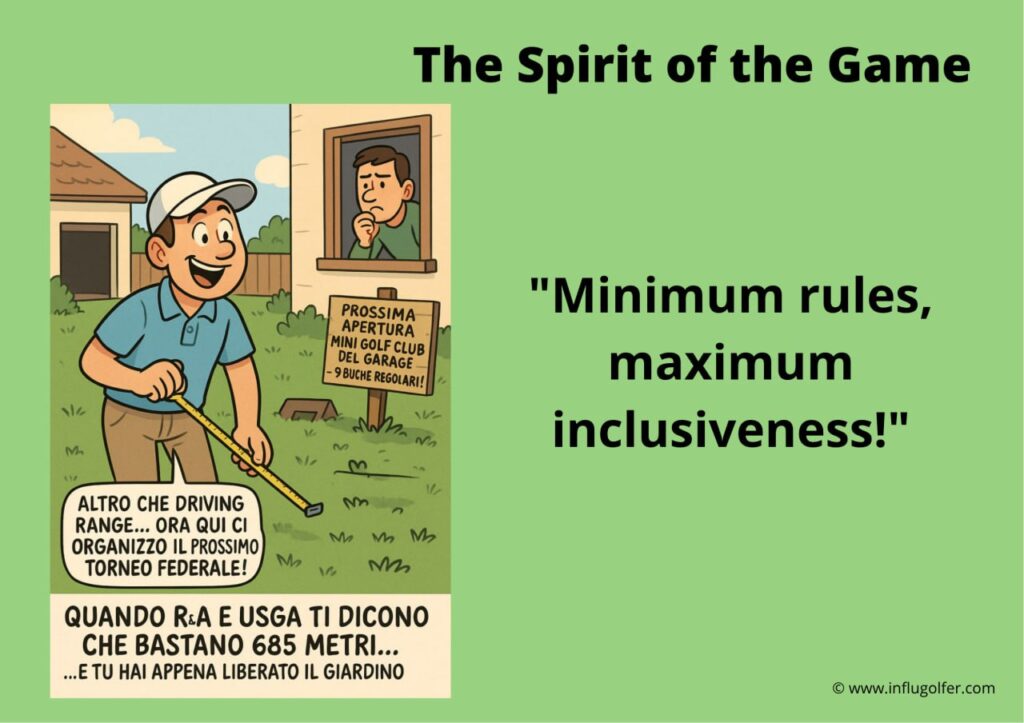
It means that from now on, to have a certified 9-hole course, only 685 meters are required.
For an 18-hole course, the threshold is 1,370 meters.
And each hole, to be certifiable, must be at least 60 meters long.
In short: more accessibility, fewer barriers (not the ones on the course!), and a new era for Italian golf.
What’s changing (and why)
The Federal Council of the FIG approved these changes on March 27, 2025 (CONI Resolution No. 169 of May 22, 2025), updating the Technical-Sports Regulations for Facilities and Certification Procedures.
This update is part of a broader international framework: the new minimum requirements were already made official in November 2023 by the USGA (United States Golf Association) and R&A (The Royal and Ancient Golf Club of St Andrews), the two global authorities on golf rules.
But this isn’t just about “shortening the course.” The WHS system has been optimized to correctly calculate Course Rating and Slope Rating even with shorter holes.
This means that results obtained on these courses will be valid for handicap purposes, just like those on longer layouts.
Explaining how this change came about—and why it was necessary—is Richard Cau, President of the Handicap and Course Rating Committee of the FIG and a member of both the WHS Handicap Committee and the EGA (European Golf Association). According to him:
“R&A and USGA, after years of studies and evaluations, deemed this change essential to facilitate and promote the practice of our sport. […] The system has been adapted to produce accurate values even for short courses, allowing for proper handicap management just like on courses over 2,750 meters.”
A true democratization of the green
This change lowers the entry barriers for those who want to build new facilities, promote golf in urban areas, or make the sport more accessible for beginners.
Small courses, big opportunities.
The change only affects the playing course (not the additional structures), but it still represents a major turning point.
There are already short courses in Italy that meet the new requirements, and others that could comply with just a few adjustments.
Cau adds:
“The most significant impact is on new facilities: it will be much easier to create a certified course that can be used for competitions. This will make golf more appealing, not only to those who already play but also to newcomers.”
And that’s no small thing, considering how much modern, accessible, and sustainable infrastructure is needed to support sports.
One final technical note on certification validity:
- For outdoor courses, certification is valid for 10 years.
- For indoor courses, it’s valid for 5 years.
- Any major modification to the course will require new certification.
Conclusion: Mini size, maximum impact
With these new measures, golf truly becomes “tailored” for everyone.
It’s easier to launch projects, more room for creativity, and more opportunities to engage beginners, youth, and communities where golf was previously hard to access.
The ball—well, the golf ball—is now in the hands of designers, clubs, course managers, and… future golfers!
Sources:
– CONI National Board Resolution No. 169 of May 22, 2025, Approval of the Certification Regulations for Sports Facilities, based on the “Guiding Principles for the Development of Sports Facilities”
– FIG Circular No. 6 of June 9, 2025, Changes to the Technical-Sports Regulations for Facilities and Certification Procedures, revising WHS measurements
– WHS – World Handicap System, in effect since February 2024, Appendix G
– FIG News, June 11, 2025, Minimum Course Measurements: A New Era Begins
Influgolfer ©